
When Concrete Purlins Won’t Budge: How I Saved Clients Thousands Without Touching Their Structure
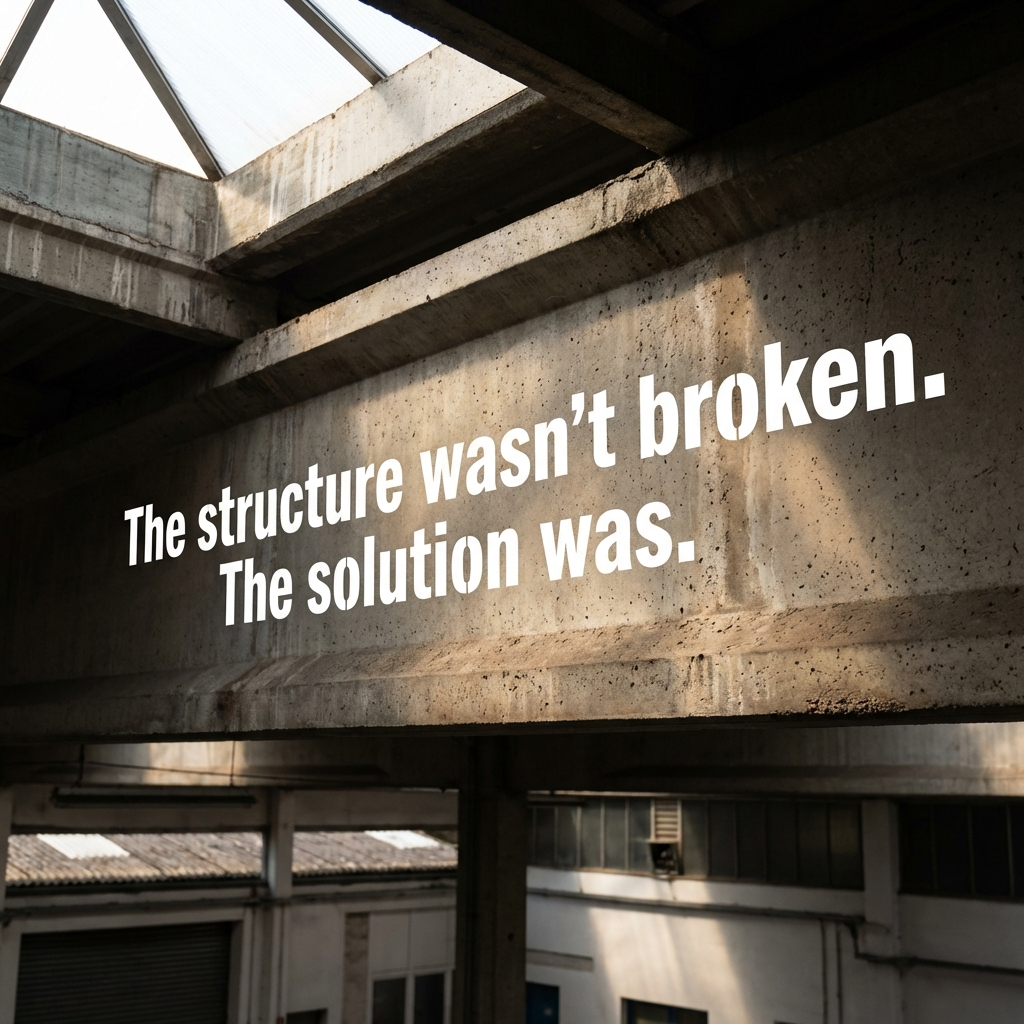
The client sat across from me, frustrated. Three contractors had already told him the same thing: to upgrade his building’s thermal performance, he’d need to replace the entire roof structure. The concrete purlins had to go.
But here’s what bothered me: the purlins were perfectly sound. Those concrete purlins had been holding up that roof for decades without issue. The problem wasn’t structural integrity. The problem was that nobody knew how to fix modern insulated roof panels to concrete without drilling into it.
And drilling into compressed concrete purlins? That’s not just risky. It’s a disaster waiting to happen.
One Case Study of a Concrete Roof Refurbishment Failing
I already knew it was a bad idea. But watching what happened when someone tried it anyway reinforced exactly why you can’t take shortcuts with concrete purlins.
A few years back, a contractor replaced a flat roof with a pitched roof on a busy shopping center. They secured the new substructure to the concrete deck with concrete Tek screws. Standard practice, they thought.
During a moderate wind storm, the entire roof blew off.
The shopping center shut down for weeks. If that structure had fallen on pedestrians, people could have been critically injured or killed. The contractor faced massive liability. The building owner faced enormous costs.
All because someone drilled into concrete without understanding what happens inside that material.
Why You Can’t Drill Into Concrete Purlins
Here’s what most contractors miss:
Concrete purlins contain tensioned steel rods running through them. When you drill and attempt to fix screws, the screw hits these rods. This damages the tensioned steel and prevents the screw from seating fully. You can’t get a proper fixing.
Second issue: the concrete itself is under tension. When you drill into prestressed concrete, it blows out and splits around the hole.
The result? No secure fixing and potential structural damage to a purlin that was working perfectly before you touched it.
And here’s the dangerous part: if you drill into concrete purlins and use concrete screws anyway, those fixings will fail. Just like they did at that shopping center. When wind loads hit the roof, the screws pull out or the concrete around them crumbles.
The entire roof assembly comes loose. In a moderate storm, it can blow off completely.
That’s not just property damage. That’s a catastrophic failure that could kill someone.
The Water Damage Problem Nobody Talks About
There’s a completely separate reason concrete purlins fail, and it has nothing to do with drilling.
Concrete is porous by nature. When a roof has been leaking for years, water gradually penetrates into the concrete. Eventually, that water reaches the tensioned steel rods inside.
The steel rusts. As it rusts, it expands. That expansion creates enormous internal pressure that cracks the concrete from the inside out. The purlin blows out and fails.
This isn’t a structural flaw. It’s a maintenance failure. The purlin would have lasted decades if the roof had been properly maintained.
The Assessment That Determines Everything
When I survey a building with concrete purlins now, I’m looking for one thing first: water damage.
Any commercial building with concrete purlins is an ideal candidate for refurbishment. But if the roof has been leaking for too long, the damage is already done. The porous nature of concrete allows water to attack the rebar from the inside.
You’ll see the signs: water stains, surface deterioration, concrete that’s started to blow out.
Here’s what surprises most people: a large majority of industrial and commercial buildings in the UK are not well maintained. Simple maintenance would prevent the costly replacement of structural elements. Over a 50-year building lifespan, proactive roof maintenance saves approximately £245,000 in avoidable capital expenditure.
But most concrete purlins I survey are ideal candidates for our solution.
Even when purlins have blown, it’s usually just the eaves purlin. We overcome this by installing a new purlin alongside the gutter. Problem solved without touching the main structure.
The Road Sign Moment
I was actively searching for a solution when the idea hit me.
I have an engineering background. I knew there had to be a way to secure something to concrete purlins without drilling. I started thinking about how other industries solve similar problems.
Road signs.
Road signs are secured to posts using steel straps. They clamp around the post without penetrating it. The pressure holds everything in place, even in high winds.
What if we could use the same principle for roof purlins?
I started researching and found something that surprised me: Kingspan had already developed solutions for exactly this problem. Their EU97 and EU71 technical updates provided manufacturer-approved methods for fixing insulated roof panels to concrete purlins without drilling.
Since then, they’ve refined these approaches into two distinct systems.
Why Manufacturer Approval Matters More Than Custom Engineering
I could have designed my own system. I had the engineering knowledge. The physics made sense.
But here’s what I learned: finding and using manufacturer-approved details shifted the solution from something that merely worked to something that was defensible.
A competent contractor can technically design a bespoke fixing system. But doing so transfers full responsibility for structural performance, wind uplift, warranty, and long-term behaviour onto the installer.
Think about what happens five years down the road when an insurance claim comes up. Or when a loss adjuster questions the installation method. Or when wind damage occurs and someone needs to determine liability.
By following Kingspan-recognized details, the load path, fixing capacities, and performance under wind loading are already tested and validated. This protects panel warranties and avoids disputes with insurers, surveyors, or loss adjusters.
These details don’t just reduce engineering risk. They protect the client, the building, and the contractor long after installation is complete.
Many commercial insurance policies require routine maintenance and periodic inspections as proof of upkeep. If a loss traces back to negligence or unapproved installation methods, an insurer can reduce or deny a claim.
The Two Solutions: EU97 vs EU71
Kingspan’s approved methods give you two options, each with specific advantages.
EU97: Timber Battens with Stainless Steel Banding
This system uses timber battens secured to concrete purlins with stainless steel banding. The bands wrap around the purlin and clamp the timber in place without penetration.
Advantages:
• Lower material cost
• Faster installation
• Adequate for most single-tenant buildings
• Proven performance in standard applications
Limitations:
• Less visually refined under metal roofing
• Fire spread concerns in multi-tenant buildings
• Not suitable where party wall fire regulations apply
EU71: Galvanized Steel Top-Hat Sections with Hook Bolts
This system uses galvanized steel top-hat sections clamped to purlins with hook bolts. The metal-to-metal connection provides a more robust fixing.
Advantages:
• Superior aesthetic under metal roofing
• Non-combustible (critical for fire regulations)
• Required for multi-tenant buildings with party walls
• Enhanced long-term durability
Limitations:
• Higher material cost
• Slightly longer installation time
The Fire Regulation Reality
Here’s something that catches people off guard: where a building is shared by numerous tenants, a metal top-hat would be the only option.
Building regulations require non-combustible materials in fire-rated assemblies. Timber battens could potentially spread fire between party walls in multi-tenant configurations.
I’ve had clients push back on this. They want the cheaper timber option. But when fire regulations force the steel solution, there’s no negotiation.
This isn’t about preference. It’s about compliance and safety.
The Real Cost Comparison
Let’s talk numbers.
Replacing concrete purlins isn’t an option. The purlins contribute towards the overall structural integrity of the building. Replacing them means replacing the entire structure—demolition, new steelwork, new roofing systems, and massive construction disruption.
That level of structural replacement can easily run into hundreds of thousands of pounds for a typical industrial building.
Our refurbishment approach using EU97 or EU71 systems? Around £35-45 per linear meter of purlin.
The cost difference is substantial.
But the cost savings go beyond just materials and labour. Consider the disruption factor. Completely tearing off and replacing a roof means shutting down operations or significantly limiting building use during construction.
Our refurbishment approach allows most facilities to remain operational throughout the installation.
The Sustainability Angle Nobody Talks About
Here’s what really matters to me: we’re not creating waste.
The UK’s construction and demolition sector generated 63.0 million tonnes of non-hazardous waste in 2022. Only 59.4 million tonnes was diverted from landfills.
Every concrete purlin we save from demolition is tonnage that doesn’t end up in a landfill. Every existing structure we extend is embodied carbon we’re preserving.
Leaders in the built environment have embraced reusing buildings and their components, minimizing new build activity wherever possible, and retaining as much of existing buildings as possible when refurbishing.
This isn’t just good environmental practice. It’s good business.
When you can upgrade a building’s thermal performance to modern standards while preserving its structural elements, you’re offering clients a solution that’s economically and environmentally superior to replacement.
What I’ve Learned About Collaboration
This work taught me something important about how manufacturers, engineers, and contractors need to work together.
Kingspan developed the technical solutions. Engineers validated the load paths and performance criteria. We contractors implement the systems in real-world conditions.
None of us can do this alone.
The manufacturer provides the tested, approved methodology. The engineer ensures site-specific conditions are addressed. The contractor brings practical installation knowledge and problem-solving when field conditions don’t match drawings.
When this collaboration breaks down, projects fail. When it works, we solve problems that seemed impossible.
The Lesson That Stuck
That client I mentioned at the beginning?
We upgraded his building using the EU71 system for £68,000. His facility stayed operational throughout the installation. The thermal performance now meets modern standards. The existing concrete purlins are still doing exactly what they were designed to do.
He saved £132,000 and avoided months of operational disruption.
But more than that, we proved something important: structurally sound buildings don’t need replacement just because fixing methods haven’t kept up with modern materials.
The concrete purlins aren’t the problem. They never were.
The problem was assuming we had to work through them instead of around them.
Sometimes the best solution isn’t the one that changes the structure. It’s the one that respects what’s already there and finds a smarter way forward.
To upload drawings, specs and plans please go to the form on our contact page.
Get in Touch